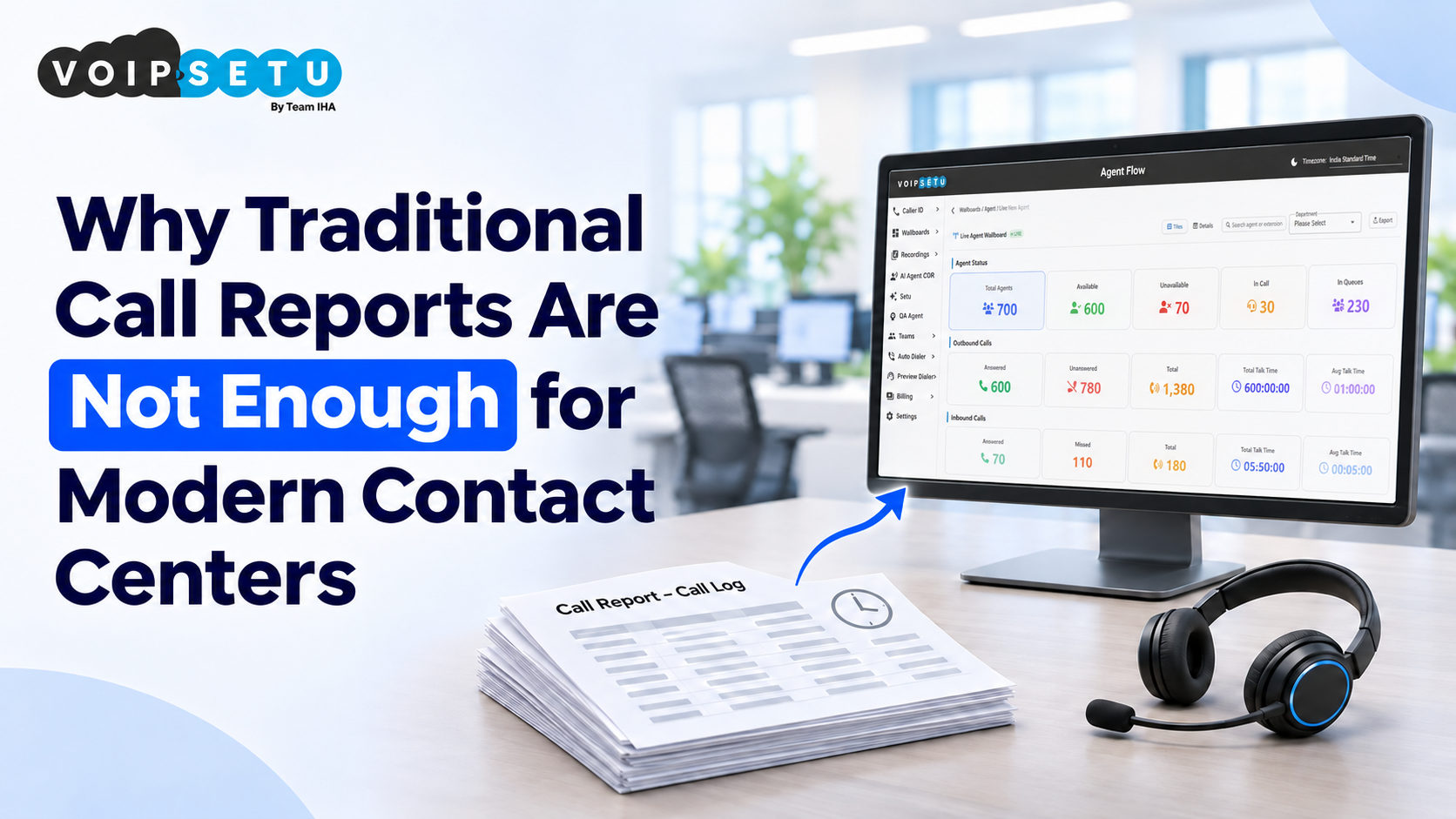
Every contact center generates a large amount of call data every day. From incoming and outgoing calls to missed calls, agent activity, call duration, and queue performance, this information helps businesses understand their communication operations.
Traditional call reports have been used for years to track this activity. They provide useful records of what happened during a particular period. However, as contact centers grow and customer expectations increase, simply reviewing historical call data is no longer enough.
Managers need to understand not only how many calls were handled but also what is happening in real time, where performance issues exist, and how operations can improve.
This is why modern contact centers are moving beyond traditional call reporting towards better visibility, advanced analytics, and AI-powered reporting.
What Are Traditional Call Reports?
Traditional call reports are records of communication activity generated by a business phone system or contact center. They help managers review call performance over a selected period.
Common information available in these reports includes:
-
Total incoming and outgoing calls.
-
Answered, missed, and abandoned calls.
-
Call duration and timestamps.
-
Agent-wise call activity.
-
Queue performance and call history.
These reports are useful for tracking historical performance and maintaining communication records. However, the challenge is turning this information into meaningful insights that support everyday decisions.
Why Traditional Call Reports Are No Longer Enough
As contact center operations become more complex, basic reporting has several limitations. Here are some common challenges businesses face.
1. Limited Real-Time Visibility
Traditional reports generally focus on historical call activity. Managers may review them at the end of a shift or day, which means they might not identify an issue while it is happening.
For example, if a particular queue suddenly receives more calls than usual, supervisors need to know about the situation before waiting times increase.
Real-time monitoring helps managers view active calls, agent availability, and queue activity while operations are running. This makes it easier to identify issues and respond at the right time.
2. Too Much Data, Not Enough Insights
Call reports can contain large amounts of information but understanding that information often requires manual analysis.
Managers may need to compare multiple reports to answer questions such as:
-
Which queue has the highest missed calls?
-
When does call volume reach its peak?
-
Which agents are handling the most calls?
-
Where are performance gaps occurring?
Modern contact center analytics helps businesses move beyond basic numbers and understand patterns that can support better decisions.
3. Difficulty Monitoring Agent and Queue Performance
Agent activity and queue performance are important indicators of contact center efficiency.
Traditional reports may show individual call statistics, but supervisors often need to compare multiple metrics to understand the complete picture.
For example, a high number of calls handled does not always mean an agent is performing efficiently. Call duration, availability, and call handling patterns also matter.
Similarly, monitoring multiple queues becomes difficult without clear visibility into waiting calls, active calls, abandoned calls, and SLA performance.
4. Manual Reporting Takes Time
In many contact centers, managers still export reports, apply filters, compare data, and prepare summaries manually.
As reporting requirements increase, this process can become time-consuming. Instead of focusing on performance improvement, supervisors spend valuable time collecting and organising information.
AI-assisted reporting and better analytics tools can simplify how users access and review call data.
5. Limited Understanding of the Complete Call Journey
A customer call may pass through IVR, different queues, transfers, and agent handling before reaching its final stage.
Basic call reports may provide individual call records, but understanding the complete call flow can require additional investigation.
Call journey visibility helps managers understand how calls move through the system and identify stages where communication issues may occur.
What Modern Contact Centers Need Beyond Traditional Reporting
Modern contact centers need reporting capabilities that support both historical analysis and ongoing operational monitoring.
| Capability | Business Value |
|---|---|
| Real-Time Monitoring | Visibility into live calls and agent activity |
| Advanced Analytics | Better understanding of performance trends |
| Queue Monitoring | Tracking waiting calls and queue activity |
| Agent Performance Tracking | Reviewing individual agent activity |
| SLA Monitoring | Understanding service-level performance |
| AI-Powered Reporting | Easier access to reporting insights |
| Call Journey Tracking | Understanding complete call flows |
These capabilities work together to provide a clearer picture of contact center performance.
How AI Is Changing Contact Center Reporting
Artificial intelligence is making it easier for businesses to access and understand their call data.
Traditional reporting often requires users to navigate different sections, apply filters, and manually review information. AI-powered reporting introduces a more conversational approach.
Instead of searching through multiple reports, users can ask questions in natural language.
For example:
"Show missed calls by queue."
Or:
"Show me the call activity for Extension 101 in May."
AI Smart Reports can help users access relevant information, review summaries, and explore call activity more conveniently.
This reduces dependence on manual report navigation and makes reporting information easier to explore.
Traditional Call Reports vs Modern Reporting
| Traditional Reporting | Modern Reporting |
|---|---|
| Mainly historical data | Historical and real-time visibility |
| Fixed report formats | Flexible reporting queries |
| Manual data analysis | AI-assisted insights |
| Separate reports for different metrics | More connected performance visibility |
| Limited live monitoring | Real-time agent and queue monitoring |
Traditional reports still have value, but modern reporting provides additional ways to understand and use contact center data.
How VoIPSetu Helps Modernise 3CX Reporting
For businesses using 3CX, call records are only one part of contact center management. Supervisors also need better reporting, live monitoring, and visibility into call handling.
VoIPSetu extends 3CX with additional contact center and telephony capabilities.
AI Smart Reports
AI Smart Reports helps users explore call reporting information through natural-language queries. Instead of manually navigating multiple reporting sections, users can ask questions about their call activity and access relevant insights.
Advanced Real-Time Wallboard
The Advanced Real-Time Wallboard provides visibility into live agent status, active calls, queue activity, and SLA-related indicators. It helps supervisors understand ongoing operations through a centralised dashboard.
Call Journey Explorer
Call Journey Explorer helps users understand how calls move through different stages of the system. This additional visibility supports call flow analysis and helps teams investigate call handling patterns.
Move Beyond Traditional Call Reporting with VoIPSetu
Modern contact centers need more than historical call records. They need practical ways to monitor operations, understand performance, and access useful reporting information.
With VoIPSetu's 3CX capabilities, businesses can benefit from:
-
AI Smart Reports: Explore call data using natural-language queries.
-
Real-Time Wallboard: Monitor agents, calls, queues, and SLA indicators.
-
Call Journey Explorer: Understand individual call flows.
-
Better Operational Visibility: Access important contact center activity more effectively.
Conclusion: Better Reporting Starts with Better Visibility
Traditional call reports remain useful for reviewing historical communication activity. However, modern contact centers need more than basic numbers and fixed reports.
Real-time monitoring, advanced analytics, and AI-powered reporting help businesses understand performance more effectively and identify areas that need attention.
The goal is not simply to generate more reports. It is to make better use of the information already available.
FAQs
What are the limitations of traditional call reports?
Traditional call reports mainly focus on historical data and fixed reporting formats. They may require manual analysis and offer limited visibility into ongoing call activity.
What is the difference between call reporting and contact center analytics?
Call reporting presents information such as call volume, duration, and missed calls. Contact center analytics goes further by helping businesses understand performance patterns and operational trends.
How does AI improve contact center reporting?
AI helps users explore reporting information through natural-language queries, access summaries, and understand call activity without depending entirely on manual report navigation.
Why is real-time monitoring important?
Real-time monitoring helps supervisors track ongoing calls, agent availability, and queue activity so they can identify operational issues while the contact center is running.
Can 3CX reporting be enhanced?
Yes. Additional tools can extend 3CX reporting and monitoring capabilities. VoIPSetu offers AI Smart Reports, Advanced Real-Time Wallboard, and Call Journey Explorer to support better operational visibility.
Something to sit with
If your 3CX could quietly tell you the one thing it's seeing right now — would you want to know?
VoIP Setu is built by people who've sat in the supervisor seat. No pitch, no pressure — just a 20-minute walkthrough on your own SC tier, and you decide.