
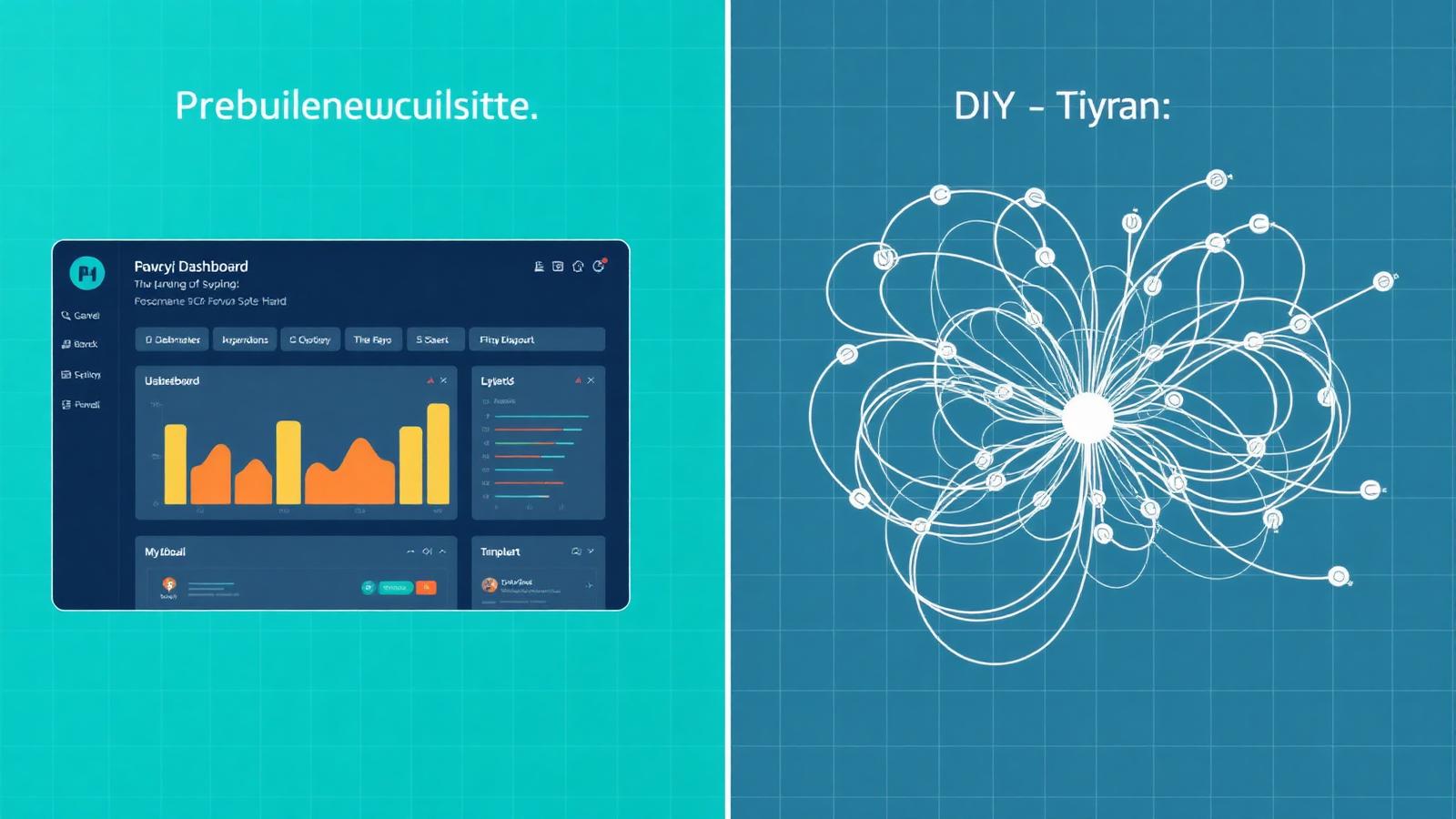
Almost every call-center ops lead we meet already has a dashboard. It's usually one of three things: a Google Sheet that someone updates twice a day, a Power BI report wired into a CDR export, or an internal tool a developer built two years ago that nobody wants to touch.
These work. Until they don't. This post is an honest breakdown of where the DIY approach quietly costs more than it saves — and what you're actually paying for when you choose VoIPSetu Agent Flow instead.
The two VoIPSetu SKUs, briefly
So the comparison makes sense, here's the split:
- VoIPSetu (APIs only) — 200+ APIs that run on your existing 3CX server. No extra hardware. You bring the dashboard, the BI tool, the integration code. Cheapest tier, maximum flexibility.
- VoIPSetu + Agent Flow — the same APIs plus a prebuilt operational dashboard (wallboards, supervisor console, agent panel, AI analytics, IVR builder, recording manager). Requires a dedicated server.
DIY = the first SKU plus your own front end. Agent Flow = the second SKU. The APIs are identical. What changes is who builds the screens.
Where DIY genuinely wins
Let's be fair before we're critical:
- You own the UX. No vendor opinion about how a wallboard should look.
- It composes with your existing BI stack. If your whole company already lives in Looker or Power BI, fighting that is silly.
- Lower license cost. You're paying for the APIs, not the prebuilt UI.
If you have a serious internal dev team and a real product owner who treats the dashboard as a product, DIY is a defensible choice. We sell the APIs-only SKU for exactly this reason.
Where DIY quietly breaks down
The four places we see DIY dashboards fail — usually 6-18 months in:
1. Real-time is harder than it looks
Pulling CDRs into a sheet every 5 minutes is not real-time. A wallboard a supervisor trusts has to update sub-second when an agent goes off-hook, when a queue depth crosses a threshold, when a call abandons. That's WebSockets, state reconciliation, and reconnect logic — not a SELECT query on a schedule.
2. Supervisor actions need a full app, not a report
A report shows you the problem. A console lets you do something about it — whisper to an agent, force-log them out, transfer a stuck call, reassign a queue. The moment your dashboard needs to trigger actions, you're not building a report anymore. You're building an application, with auth, audit logs, RBAC, and a release cycle.
3. AI analytics is a product, not a feature you bolt on
Transcription, sentiment, summarization, QA scoring — each is a separate model, with separate costs, separate latency profiles, and separate accuracy tuning. Wiring OpenAI to a CDR table and calling it "AI analytics" works in a demo. It does not work when 4,000 calls a day hit it and the bill arrives.
4. The person who built it leaves
The single biggest hidden cost of DIY. The dev who knew how the CDR export worked, where the cron job lived, why that one query has a hard-coded row limit — they leave. Now it's a critical piece of ops infrastructure that nobody owns. We've inherited a lot of these.
What Agent Flow is, in plain terms
Agent Flow is the prebuilt answer to the above:
- Wallboards that update in real time, out of the box, on the same screen supervisors already keep open.
- Supervisor Console with whisper / barge / monitor, transfer, force-state, and audit-logged actions.
- Agent Panel — a single pane each agent uses for call control, CRM popup, disposition, and AI-suggested next action.
- AI Smart Reports — transcription, summarization, QA scoring, sentiment trends, all tuned for call-center audio (not generic meetings).
- IVR Builder — no-code canvas an ops lead can use without filing a dev ticket.
- Recording Manager with semantic search across transcripts.
It runs on its own server (we'll size and provision it with you) because it's a real application, not a report.
The honest decision framework
Choose APIs-only if:
- You have a full-time dev team that already maintains internal tools.
- Your BI investment is large enough that another UI would split attention.
- Your call volume is low enough that real-time isn't critical.
Choose Agent Flow if:
- Your ops team is bigger than your dev team.
- Your supervisors need to act, not just look.
- You want AI analytics that work on day one, not a six-month project.
- You'd rather pay a predictable license than carry a maintenance burden of unknown size.
Most teams over 30 seats land on Agent Flow. Most teams under 15 seats and with a strong dev culture stay on APIs-only. The middle is a real choice — and we'll tell you honestly which one fits in a 20-minute call.
What we won't do
We won't tell you Agent Flow is cheaper than DIY in raw license cost. It isn't. It's cheaper in total cost of ownership — once you count the dev hours, the on-call rotation, the AI bill surprises, and the person who eventually leaves. If those costs are zero in your world, the APIs SKU is the right answer.
That's the comparison. No marketing math, no "10x productivity" claims. Just the trade-offs we see repeat across hundreds of 3CX deployments.
Three teams. Three quiet wins.
None of these stories started with a software purchase. They started with a question the existing reports couldn't answer.
A 25-seat support team with one strong full-stack dev
They'd already built a Power BI report on top of 3CX CDRs and didn't want to throw it away.
What changed
Bought VoIPSetu APIs-only, kept Power BI for historical reporting, used the APIs to add real-time call control to their internal tool. No Agent Flow.
A 70-seat BPO whose 'dashboard' was a Google Sheet updated every 15 minutes
Supervisors were making staffing calls on data that was already wrong by the time they saw it.
What changed
Switched to Agent Flow. Wallboards live on day three. The sheet still exists, but nobody opens it anymore.
A regional 3CX partner serving 40 SMB customers
Each customer wanted 'a dashboard' but none had budget for a custom build.
What changed
Partner standardized on Agent Flow as the upsell SKU — one product to support, predictable margin, no bespoke code per customer.
Something to sit with
If the developer who built your current dashboard left this Friday, would your Monday morning still have a wallboard?
VoIP Setu is built by people who've sat in the supervisor seat. No pitch, no pressure — just a 20-minute walkthrough on your own SC tier, and you decide.